
Single Bed Size Guide: Dimensions UK & US
# Single Bed Size Guide: Dimensions UK & US
A single bed sounds simple — one person, one bed — but its measurements change by country. A UK single and a US twin are not the same bed, and a single duvet is much wider than a single mattress. Buy the wrong combination and you get a mattress that leaves a gap in the frame, or sheets that pull off.
This guide gives the exact single bed dimensions for the UK and US, in inches and centimetres, compares a single with other standard sizes, and helps you decide if it suits your room and sleeper. All figures are mattress sizes unless stated otherwise; frames run slightly larger.
Single Bed Dimensions at a Glance
UK Single: 36 x 75 inches (90 x 190 cm), or 3 ft x 6 ft 3 in.
US Twin, the US equivalent of a single: 38 x 75 inches (97 x 191 cm), or 3 ft 2 in x 6 ft 3 in.
Both are the same length. The US twin is 2 inches (7 cm) wider — enough for a UK single sheet to fit a US twin mattress badly, and for a US twin mattress not to sit correctly in a UK single frame. Buy all three in the same country's sizing.
UK sizes are defined in centimetres, so inch figures are rounded: a UK single is exactly 90 cm wide (35.4 inches).
UK Single Bed Dimensions
The standard UK single measures 36 x 75 inches (90 x 190 cm). It is sold as a 3 ft bed and is the standard single across the UK and Ireland. A small single, at 30 x 75 inches (75 x 190 cm), suits young children and some bunk beds, but is too narrow for most adults.
| UK Bed Size | Inches (W x L) | Centimetres (W x L) |
|---|---|---|
| Small Single | 30 x 75 in | 75 x 190 cm |
| Single | 36 x 75 in | 90 x 190 cm |
| Small Double | 48 x 75 in | 120 x 190 cm |
| Double | 54 x 75 in | 135 x 190 cm |
| King | 60 x 78 in | 150 x 200 cm |
| Super King | 72 x 78 in | 180 x 200 cm |
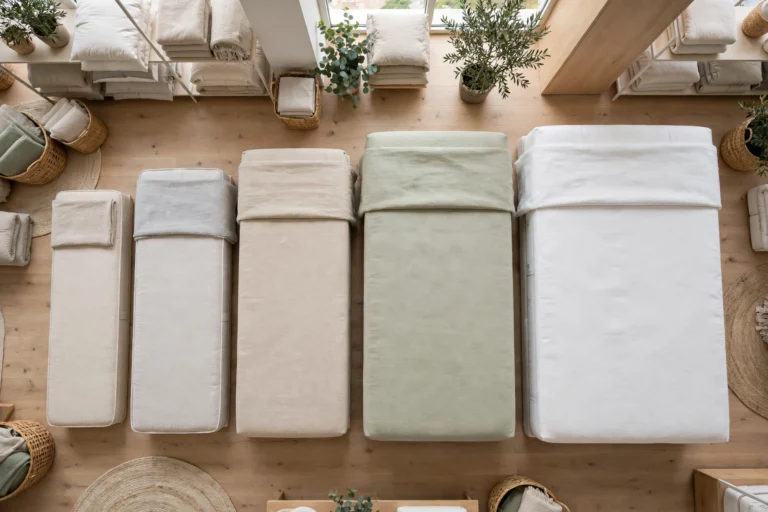
The single, small double and double share the same length — 75 inches (190 cm) — and only the width changes: a small double adds 12 inches (30 cm) over a single, a double adds 18 inches (45 cm). The king and super king are longer too, at 78 inches (200 cm).
US Single Bed Dimensions: The Twin
The US does not use "single" as a standard size. The smallest standard US bed is the twin, the direct equivalent of a single, measuring 38 x 75 inches (97 x 191 cm). American shops also label it "twin/single": "single" means a 36-inch bed in the UK and a 38-inch bed in the US.
| US Bed Size | Inches (W x L) | Centimetres (W x L) |
|---|---|---|
| Twin | 38 x 75 in | 97 x 191 cm |
| Twin XL | 38 x 80 in | 97 x 203 cm |
| Full / Double | 54 x 75 in | 137 x 191 cm |
| Queen | 60 x 80 in | 152 x 203 cm |
| King | 76 x 80 in | 193 x 203 cm |
| California King | 72 x 84 in | 183 x 213 cm |
The twin XL is the size used in most American college dorm rooms: the same width as a twin, 38 inches (97 cm), but 5 inches (12 cm) longer at 80 inches (203 cm). There is no exact UK equivalent; the nearest is a long single, 36 x 79 inches (90 x 200 cm).
UK Single vs US Twin
| Feature | UK Single | US Twin |
|---|---|---|
| Width | 36 in (90 cm) | 38 in (97 cm) |
| Length | 75 in (190 cm) | 75 in (191 cm) |
| Floor area | 18.8 sq ft (1.71 sq m) | 19.8 sq ft (1.85 sq m) |
Length is effectively the same: 190 cm against 191 cm is a 1 cm difference. Width is the real difference — 7 cm. A US twin gives a little more elbow room; a UK single feels more compact, an advantage in a small room and a disadvantage for a broad or restless sleeper.
A UK single mattress is too narrow for a US twin frame, leaving a gap of about 7 cm, and a US twin mattress is too wide for a UK single frame. Bedding does not cross over either: a UK single sheet fits 90 x 190 cm, a US twin sheet fits 97 x 191 cm. A UK king is almost the same as a US queen, while a UK super king is much smaller than a US king.
Who a Single Bed Is For
Children and teenagers. This is the single bed's natural home. A child leaving a cot, and a teenager who has outgrown a first bed, both fit comfortably on 36 inches (90 cm) or 38 inches (97 cm). The bed leaves room for a desk and wardrobe, which a double would not.
Guest rooms. A single suits a spare room that must sleep one guest without dominating the space. Two singles sleep two people and can be separated again, which is why twin rooms are still common in hotels.
Small bedrooms, studios and box rooms. Where a double would leave no walking space, a single is often the only bed that works. It fits against one wall and leaves room for storage — ideal for a home office that doubles as a guest room or a studio flat.
Single adults in compact homes. Many adults sleep happily on a single, especially in cities with small bedrooms. If you sleep mostly in one position and do not share the bed, 36 inches (90 cm) is enough.
Bunk beds, day beds and dorm rooms. Most bunk beds and high sleepers are built around a single mattress. In the US, twin and twin XL beds dominate dorm rooms: they fit, they are cheap, and two make a king.
Who a Single Bed Is NOT For
Couples. A single is made for one person. Two adults on a 36-inch (90 cm) mattress each get 18 inches (46 cm) — less than a standard cot's width. Couples should start at a double, 54 inches (135–137 cm) wide.
Tall sleepers. A standard single is 75 inches (190 cm) long. National Bed Federation guidance says a mattress should be at least 10 cm longer than its tallest user, so a 190 cm mattress suits someone up to about 180 cm (5 ft 11 in). If you are 6 ft (183 cm) or taller, choose a twin XL in the US, or a long single or king in the UK.
Broad or restless sleepers. An average adult man's shoulders measure roughly 18 to 20 inches (46 to 51 cm) across, leaving little spare room on a 36-inch (90 cm) mattress. If you change position often, a small double at 48 inches (120 cm) wide is a much better single-sleeper bed, and still fits most small rooms.
Anyone sharing with a child or pet. Parents who co-sleep, even occasionally, and people whose dog or cat claims a corner nightly, will find a single too small. A small double is the minimum for one adult plus a small child or medium dog; a double is more realistic for regular sharing.
Room Size Needed for a Single Bed
A single bed takes little floor space alone — 18.8 square feet (1.71 square metres) for a UK single, 19.8 square feet (1.85 square metres) for a US twin — but you also need space to walk around it, open the door, pull out drawers, and make the bed without climbing over it.
Under England's Nationally Described Space Standard, a single bedroom in a new home must be at least 7.5 square metres (about 81 square feet). In the US, the minimum is 70 square feet (6.5 square metres).
For comfort, allow at least 24 to 30 inches (60 to 76 cm) of walking space on each side you use, and about 36 inches (91 cm) in front of a wardrobe. UK guides recommend 60 to 75 cm on each side and 90 cm (about 35 inches) at the foot. With those clearances, a UK single needs a practical minimum room of about 210 x 290 cm (about 6 ft 11 in x 9 ft 6 in); a room of 2.4 x 3.0 metres (about 8 x 10 ft) is comfortable.
Measure three things before buying: the room; the frame, not just the mattress — a frame is typically 5 to 10 cm larger than its mattress on each side; and the route in, because a divan base or headboard that fits the room may not fit through the door.
Mattress and Bedding Notes
Fitted sheets. Match the mattress exactly: 90 x 190 cm (36 x 75 in) for a UK single, 38 x 75 in (97 x 191 cm) for a US twin. Also check depth: standard sheets suit mattresses up to about 30 cm (12 inches) deep, while deep sheets suit up to 38 cm (15 inches) or 46 cm (18 inches), including any topper.
Duvets and duvet covers. The duvet is much wider than the mattress: a UK single duvet measures 135 x 200 cm (53 x 79 in), 45 cm wider than the mattress, so it drapes over the sides. A UK single duvet cover is slightly larger again, 140 x 200 cm (55 x 79 in) at some retailers. In the US, buy "Twin" bedding for a twin and "Twin XL" for a twin XL.
Protectors and pillows. Buy a protector in the same size as the mattress: single in the UK, twin in the US. A single bed fits one standard pillow comfortably, two at a push.
Thickness and firmness. Thickness is not standardised like width and length: it runs from about 15 cm (6 inches) for a basic children's mattress to 30 cm (12 inches) or more for a luxury pocket-sprung mattress. Firmness is personal: side sleepers usually prefer softer, back sleepers medium-firm.
Frames, bases and storage. A frame, divan or bunk is sold by the mattress size it takes, so a "single divan" holds a 90 x 190 cm mattress in the UK and a 38 x 75 inch mattress in the US. Divans with drawers add storage; ottoman beds, where the mattress lifts to reveal storage, suit rooms with no wardrobe space.
Pros and Cons of a Single Bed
Pros
- Fits small rooms. The smallest standard bed, fitting box rooms and studios where a double would not.
- Cheapest to buy and dress. Single mattresses, frames and bedding are the least expensive standard sizes.
- Easy to move. Light enough for one or two people to carry upstairs.
- Leaves room for furniture. A desk, wardrobe or drawers can share a small bedroom with a single.
- Good for solo sleepers. One person gets all the space they need.
- Flexible in pairs. Two singles can be used separately or pushed together.
Cons
- Too narrow for two people. Not a couple's bed, even for one night.
- Too short for tall sleepers. At 75 inches (190 cm), it does not suit anyone over about 6 ft (183 cm).
- Cramped for restless sleepers. Broad shoulders and turning feel tight on 36 inches (90 cm).
- No room for children or pets. A child or dog in the bed leaves almost no space.
- Less premium choice. Some luxury models are not made in single sizes.
- Can feel temporary. In a main bedroom, a single can look like a stopgap.
Single Bed Size FAQs
1. What is the size of a single bed in the UK?
A standard UK single measures 36 x 75 inches (90 x 190 cm), or 3 ft x 6 ft 3 in — the mattress size; the frame is a few centimetres larger.
2. Is a single bed the same as a twin bed?
Not exactly, though they are the closest equivalents. A UK single is 36 x 75 inches (90 x 190 cm); a US twin is 38 x 75 inches (97 x 191 cm). Same length, but the twin is 2 inches (7 cm) wider, so mattresses, frames and sheets are not interchangeable.
3. Can two people sleep in a single bed?
They can, but should not plan to. Two adults on a UK single each get 18 inches (46 cm) — less than a cot mattress's width. For regular sharing, a double at 54 inches (135–137 cm) is the minimum.
4. What size duvet and sheets do I need for a single bed?
For a UK single, buy a fitted sheet of 90 x 190 cm (36 x 75 in) and a single duvet of 135 x 200 cm (53 x 79 in). For a US twin, buy twin sheets of 38 x 75 in (97 x 191 cm).
5. What size room do I need for a single bed?
The bed itself needs 90 x 190 cm (36 x 75 in) in the UK, or 97 x 191 cm (38 x 75 in) in the US, plus the frame. Allow 60 to 75 cm (24 to 30 inches) on each side and 90 cm at the foot, giving a practical minimum room of about 210 x 290 cm.
Conclusion
A single bed is the smallest standard bed, made for one sleeper, at the lowest price. In the UK it measures 36 x 75 inches (90 x 190 cm); in the US its twin measures 38 x 75 inches (97 x 191 cm). That 2-inch (7 cm) width difference decides whether bedding fits, and whether a mattress sits properly in its frame.
Choose a single when the sleeper is one person, the room is small, and the sleeper is under about 6 ft (183 cm) tall. Choose the next size up — a small double at 48 x 75 inches (120 x 190 cm) in the UK, or a full at 54 x 75 inches (137 x 191 cm) in the US — when the sleeper is broad, restless, tall, or likely to share the bed.