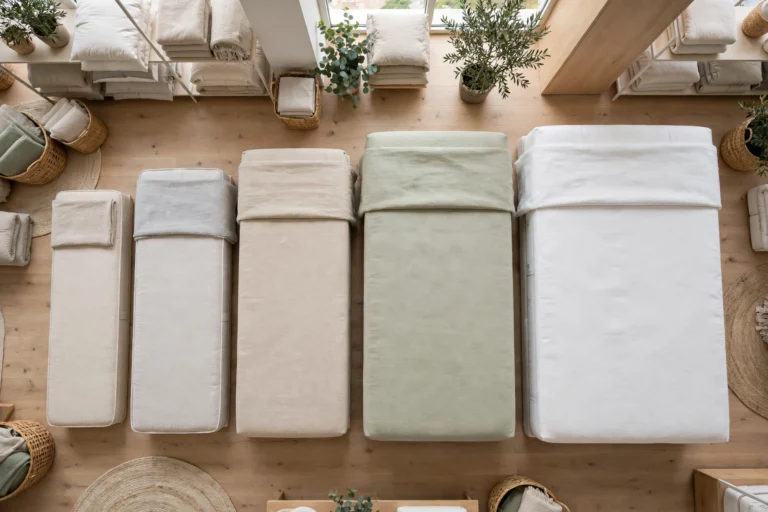

Queen Bed Size: Dimensions, Mattress & Room Guide
# Queen Bed Size: Dimensions, Mattress & Room Guide
If you are shopping for a new bed, the queen is almost certainly on your shortlist. It is the most popular mattress size in the United States: wide enough for two adults, long enough for most tall sleepers, and small enough to fit a standard bedroom. Yet "queen" does not mean the same thing everywhere. A queen bought in the United States is a very different size from a bed sold as a queen in the United Kingdom, and close cousins such as the Olympic queen and the California king can cause expensive confusion if you order the wrong bedding.
This guide gives you the exact queen bed dimensions in inches and centimetres, compares a queen with every other standard size, tells you how much room you need around it, and covers the mattress and bedding details that matter once the bed is in your home.
Queen Bed Dimensions at a Glance
A standard US queen mattress measures 60 inches wide by 80 inches long (152 x 203 cm) — 5 feet wide by 6 feet 8 inches long. It covers about 33.3 square feet (3.1 square metres), or 30 inches (76 cm) of width per person when two people share it.
That 60 x 80 inch figure is the mattress itself. The bed frame around it is always a little larger: a typical queen frame adds roughly 2 to 5 inches (5 to 13 cm) on each side for the rails, plus extra length for a headboard or footboard. Plan on a footprint of about 64 x 84 inches (163 x 213 cm) for the assembled bed, and measure your own frame before you commit to a layout.
One warning: these are nominal dimensions. A real queen mattress may measure half an inch more or less than the standard, which can matter for a tight-fitting frame or a fitted sheet with a shallow pocket. Always check the actual measurements on the product page.
Queen Bed Size Chart: US and UK
The table below lists the standard bed sizes in the US and the UK, in inches and centimetres.
| Bed Size | Width (in) | Length (in) | Width (cm) | Length (cm) |
|---|---|---|---|---|
| US Twin | 38 | 75 | 97 | 191 |
| US Twin XL | 38 | 80 | 97 | 203 |
| US Full / Double | 54 | 75 | 137 | 191 |
| US Queen | 60 | 80 | 152 | 203 |
| US King | 76 | 80 | 193 | 203 |
| US California King | 72 | 84 | 183 | 213 |
| UK Single | 36 | 75 | 90 | 190 |
| UK Small Double | 48 | 75 | 120 | 190 |
| UK Double | 54 | 75 | 135 | 190 |
| UK King | 60 | 78 | 150 | 200 |
| UK Super King | 72 | 78 | 180 | 200 |
In the UK, a bed sold as a "queen" is usually a small double: 48 inches wide by 75 inches long (120 x 190 cm) — 12 inches (30 cm) narrower and 5 inches (13 cm) shorter than a US queen. The UK size closest to a US queen is the UK King at 60 x 78 inches (150 x 200 cm): the same width, but 2 inches (5 cm) shorter.
A queen is 6 inches (15 cm) wider and 5 inches (13 cm) longer than a full/double, which is why couples who start on a full so often upgrade. It is 16 inches (41 cm) narrower than a standard king — the trade-off for a bed that fits a smaller room and costs less — and 8 inches (20 cm) narrower but 4 inches (10 cm) shorter than a California king, which suits very tall sleepers.
Who a Queen Bed Is For
A queen bed is the right choice for a surprisingly wide range of sleepers — the default pick for couples in a primary bedroom, and equally popular with single sleepers who like room to spread out without paying king-size prices.
Couples. Two adults get 30 inches (76 cm) of width each — the same as a US twin mattress per person — and for most couples that is enough to sleep without elbowing each other all night. If both partners are broad-shouldered or restless, 30 inches each can feel tight, but for average-sized couples it is the sweet spot between comfort and room size.
Guest rooms and master bedrooms. A queen is the standard guest-room bed: it sleeps one or two adults comfortably and fits in a 10 x 10 foot room, while a full is noticeably tighter for two guests and a king can make a small guest room feel cramped. In most homes the primary bedroom is also designed around a queen, leaving room for two nightstands and a dresser without demanding the 12 x 12 foot room a king really needs.
Who a Queen Bed Is NOT For
A queen is a great all-rounder, but it is not the right bed for everyone. Being honest about where it falls short will save you an expensive return.
Couples who need more personal space. If you and your partner are both large or toss and turn a lot, a queen's 30 inches each will feel cramped. A king gives each person 38 inches (97 cm) — a difference that can genuinely improve sleep for restless couples.
Very tall sleepers. Anyone over about 6 feet 4 inches (193 cm) will find their feet at or beyond the end of an 80-inch queen. The California king's extra 4 inches of length is made for exactly this situation.
Tiny bedrooms. A queen needs a minimum room of 10 x 10 feet (see the room guide below). If your bedroom is smaller than that — a box room, a converted study, a small apartment bedroom — a full/double or even a twin XL will leave you with walkways you can actually use.
Tight budgets and frequent movers. A queen mattress, frame, and bedding all cost more than a full or twin, so if you sleep alone in a small room the extra width is a luxury. A queen mattress is also heavy and awkward to carry up narrow stairs or through tight doorways, so renters who move often should measure every doorway and turn on the route before ordering.
How Much Room Do You Need for a Queen Bed?
The mattress is only half the question. The other half is the room around it. Multiple room-size guides agree on the same basic figures, and they are worth taking seriously before you buy.
Minimum room: 10 x 10 feet (3.05 x 3.05 m), or 100 square feet (9.3 sq m). This is the smallest bedroom a queen fits in with usable walkways. In a 10-foot-wide room, a 60-inch mattress leaves 30 inches (76 cm) on each side before you count the frame; once the frame is in, expect about 24 inches (61 cm) of clearance on each side and at the foot — enough to walk through and make the bed, but room for only one nightstand and no dresser at the foot.
Comfortable room: 10 x 12 feet (3.05 x 3.66 m), or 120 square feet (11.1 sq m). This is the size most guides recommend as the practical standard. Two nightstands fit, a dresser works on the long wall, and the door swing stops being a problem.
Ideal room: 12 x 12 feet (3.66 x 3.66 m), or 144 square feet (13.4 sq m). At this size you get the full set: two nightstands, a dresser with drawers that actually open, and walkways you never have to sidestep through.
The rule that matters more than square footage is clearance. Plan for at least 24 inches (61 cm) of walking space on each open side of the bed and at the foot — the minimum for getting in and out and making the bed. Thirty inches (76 cm) feels comfortable, and 36 inches (91 cm) is ideal. If you need to open drawers or a wardrobe door beside the bed, allow 36 inches (91 cm) there too.
Push the head of the bed against the longest clear wall, ideally opposite the door, and keep at least one side fully clear rather than shoving the bed into a corner. Square footage alone can also mislead: a long, narrow room of 9 x 12 feet (108 square feet) often fits a queen better than a square 10 x 10 foot room, because the 12-foot wall absorbs the nightstands.
Mattress and Bedding Notes
A queen mattress is one of the easiest sizes to shop for, because it is the most common size in the US. Almost every mattress brand makes a queen, and almost every bedding brand stocks queen sheets, duvets, and protectors.
Mattress thickness. Queen mattresses vary in thickness, typically from about 8 inches (20 cm) for a slim mattress to 14 inches (36 cm) or more for a thick pillow-top or hybrid. Thickness does not change the width or length, but it changes how high the bed sits and which fitted sheet you need: a mattress plus a topper can easily reach 16 inches (41 cm) deep, so check the pocket depth before you buy. A standard pocket of around 15 inches (38 cm) fits most queen mattresses; deep-pocket sheets are made for thicker ones.
Mattress types. All the usual types come in queen: innerspring, memory foam, latex, and hybrid — so choose by comfort and support rather than by dimension. One note for couples: memory foam and pocketed-coil hybrids isolate movement better than a traditional open-coil innerspring, which matters on a shared queen if one of you is a light sleeper.
Fitted sheets. A queen fitted sheet matches the mattress: 60 x 80 inches (152 x 203 cm), plus a pocket depth to suit your mattress thickness — a shallow sheet will pop off a thick mattress in the night. Flat sheets (commonly around 90 to 96 inches wide by 102 inches long) and duvet covers (commonly around 88 to 95 inches wide by 88 to 98 inches long) are cut larger so they drape over the sides, but brands vary, so check the label.
Pillows and moving. Two standard pillows (20 x 26 inches / 51 x 66 cm each) sit neatly across a 60-inch queen; two king pillows (20 x 36 inches / 51 x 91 cm) fill the width completely. A queen mattress is bulky, so measure your doorways, hallways, stair turns, and lift before delivery day — a mattress in a box is far easier to get upstairs than a rigid traditional mattress.
Pros and Cons of a Queen Bed
Pros
- Room for two. Thirty inches (76 cm) of width per person is comfortable for most couples, and generous for a single sleeper.
- Fits standard bedrooms. A 10 x 10 foot room is enough, and a 10 x 12 foot room is comfortable — no need for a large primary suite.
- The most popular size. The widest choice of mattresses, frames, and bedding, at every price point, and the easiest size to find on sale.
- Good value. A queen typically costs noticeably less than a king mattress, frame, and bedding set, while giving up only 16 inches (41 cm) of width.
Cons
- Tight for restless or larger couples. Thirty inches each is less than a twin mattress per person, and light sleepers may feel every movement.
- Not enough for co-sleeping families. Add a child or two and the queen runs out of space quickly.
- Too short for very tall sleepers. Over 6 feet 4 inches (193 cm) and your feet will reach the end of the bed.
- Heavy and awkward to move. A queen mattress is difficult to carry through narrow doors and up stairs, especially a rigid one.
Frequently Asked Questions
1. What are the dimensions of a queen bed?
A standard US queen bed measures 60 inches wide by 80 inches long (152 x 203 cm), or 5 feet by 6 feet 8 inches. That is the mattress size; the frame will be a few inches larger. In the UK, a bed sold as a queen is usually a small double at 48 x 75 inches (120 x 190 cm).
2. Is a queen bed big enough for two people?
For most couples, yes. Each person gets 30 inches (76 cm) of width, the same as a twin mattress. It is comfortable for average-sized couples, but if both partners are broad or restless, a king — with 38 inches (97 cm) each — will sleep better.
3. What is the minimum room size for a queen bed?
The minimum is 10 x 10 feet (3.05 x 3.05 m), or 100 square feet, with at least 24 inches (61 cm) of clearance on each side and at the foot. A 10 x 12 foot room (120 square feet) is more comfortable and fits two nightstands and a dresser, and 12 x 12 feet (144 square feet) is ideal.
4. What is the difference between a queen and a king bed?
A US queen is 60 x 80 inches (152 x 203 cm) and a US king is 76 x 80 inches (193 x 203 cm). Both are the same length; the king is 16 inches (41 cm) wider, giving each sleeper 38 inches instead of 30. A king needs a larger room — 12 x 12 feet is a sensible minimum — and costs more for the mattress, frame, and bedding.
5. Will queen sheets fit a UK queen bed?
No — and this is the most common bedding mistake. US queen sheets are made for a 60 x 80 inch (152 x 203 cm) mattress, while a UK queen (small double) mattress is 48 x 75 inches (120 x 190 cm). US queen sheets will be far too loose on a UK queen, so buy small double bedding — or a UK king (60 x 78 inches / 150 x 200 cm) for the closest match to a US queen.
Conclusion
The queen bed earns its popularity. At 60 x 80 inches (152 x 203 cm) in the US, it is the smallest bed that genuinely works for two adults, the largest bed that still fits a standard 10 x 10 foot bedroom, and the size with the widest choice of mattresses and bedding at the fairest prices. Its only real weaknesses are the cases where you need more: more width for a restless partner, more length for a very tall sleeper, or more room for a co-sleeping family. Check the sizing, measure the room, match the bedding.