
Bed Sizes Explained (Complete Size Chart + Room Guide)
Bed sizes define the standard Width and Length of a sleeping surface. They help you choose the right fit for your room, your height, and your sleeping needs. Every bed category follows a measurement system based on inches, centimetres, or feet.
Many people assume sizes are universal. They are not. A UK King is different from a US King. A European Queen does not match an American Queen. Each country follows its own manufacturing standards. These differences affect sheets, frames, and overall room planning.You can Contact us.
Guideline For
- First-time buyers
- Couples upgrading their bedroom
- Parents choosing kids’ beds.
- Renters planning small spaces.
- Anyone comparing different bed sizes
- Readers searching for a reliable bed size chart.
Quick Answer Summary
- The most common options are Twin, Full, Queen, King, and California King.
- A Queen measures 60 × 80 inches (152 × 203 cm) in the US.
- A King measures 76 × 80 inches (193 × 203 cm) in the US.
- Sizes vary between the US, UK, Europe, Australia, and Asia.
- Room size matters as much as mattress size.
Standard Bed Sizes Chart
(US, UK, EU & Global)
This table compares standard bed sizes, including bed dimensions in inches and centimetres, and a quick use case for each size.
United States Bed Sizes
Size | Width × Length (inches) | Width × Length (cm) | Best For |
|---|---|---|---|
Twin | 38 × 75 | 96 × 191 | Single sleepers, kids, small rooms |
Twin XL | 38 × 80 | 96 × 203 | Taller individuals, dorm rooms |
Full / Double | 54 × 75 | 137 × 191 | Single adults needing extra Width |
Queen | 60 × 80 | 152 × 203 | Couples, most common choice |
King | 76 × 80 | 193 × 203 | Couples wanting maximum width |
California King | 72 × 84 | 183 × 213 | Taller sleepers needing extra length |
These are the most searched bed sizes in the US and serve as the basis for most global comparisons.
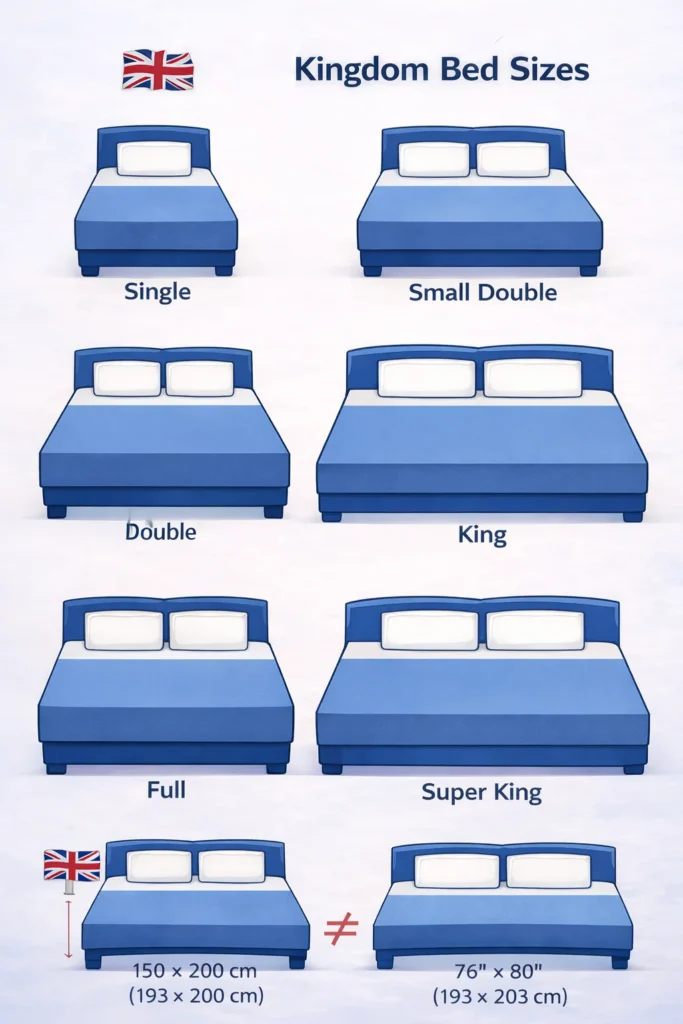
United Kingdom Bed Sizes
Size | Width × Length (inches) | Width × Length (cm) |
|---|---|---|
Single | 36 × 75 | 90 × 190 |
Small Double | 48 × 75 | 120 × 190 |
Double | 54 × 75 | 135 × 190 |
King | 60 × 78 | 150 × 200 |
Super King | 72 × 78 | 180 × 200 |
Notice that a UK King equals 60 inches wide. That matches a US Queen in Width but not Length. This is one of the most common sources of confusion in UK vs US bed sizes.
European Bed Sizes
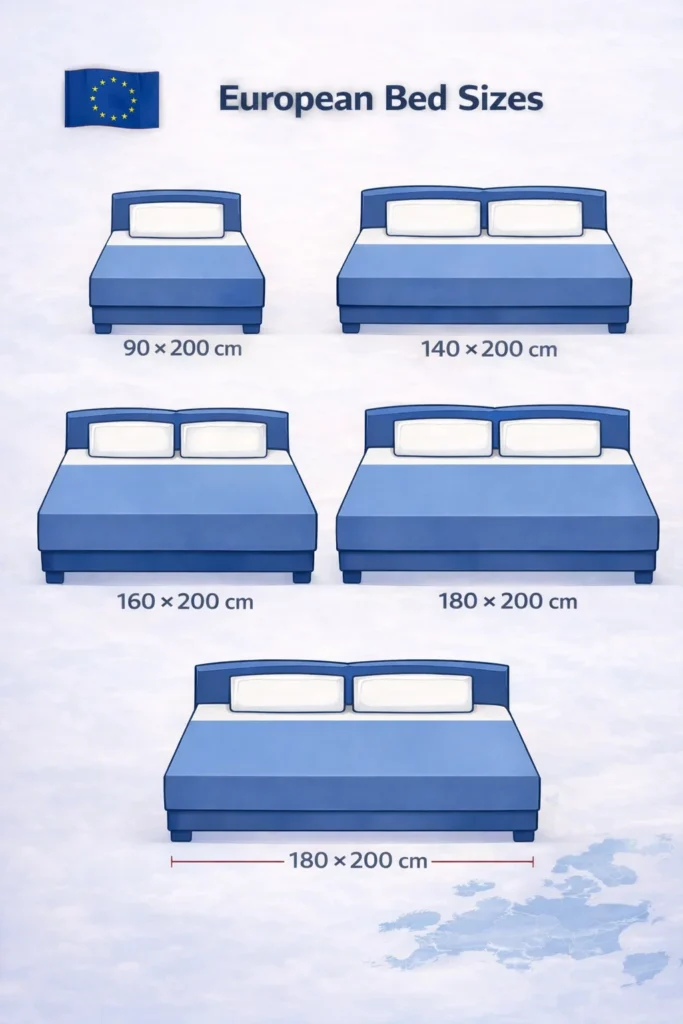
Size | Width × Length (cm) | Width × Length (inches) |
|---|---|---|
90 × 200 | 90 × 200 | 35 × 79 |
140 × 200 | 140 × 200 | 55 × 79 |
160 × 200 | 160 × 200 | 63 × 79 |
180 × 200 | 180 × 200 | 71 × 79 |
Europe uses metric measurements. Sizes vary slightly by country.European models often offer a longer standard length of 200 cm.
Australia Bed Sizes
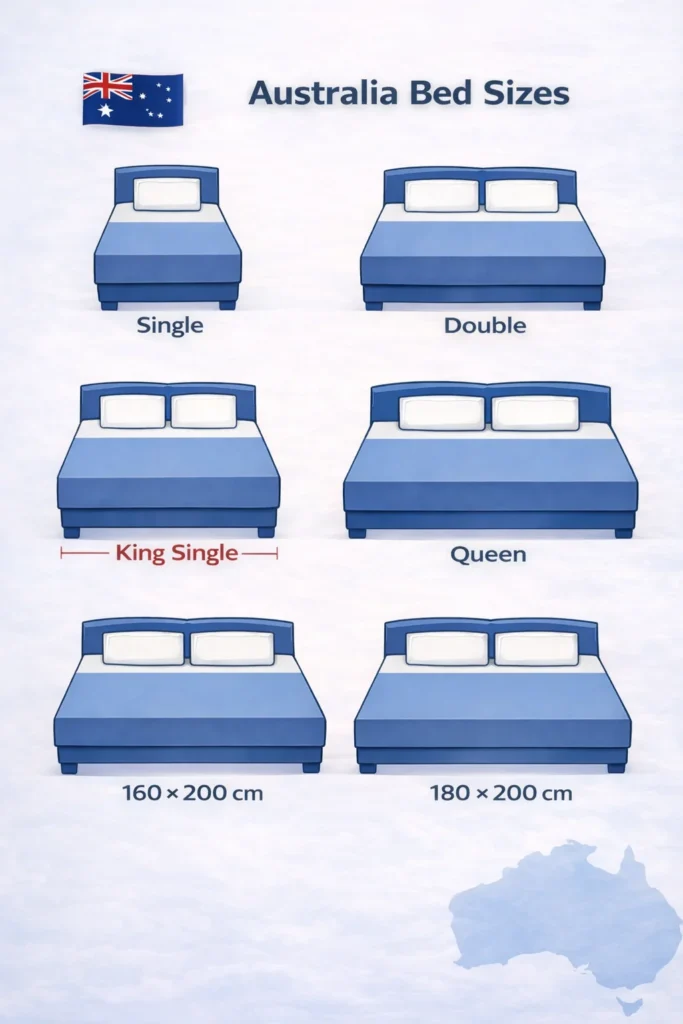
Size | Width × Length (cm) | Width × Length (inches) | Best For |
|---|---|---|---|
Single | 92 × 188 | 36 × 74 | Kids, spare rooms |
King Single | 107 × 203 | 42 × 80 | Teens, taller sleepers |
Double | 138 × 188 | 54 × 74 | Solo adults |
Queen | 153 × 203 | 60 × 80 | Couples standard |
King | 183 × 203 | 72 × 80 | Spacious master rooms |
Global Size Order (Smallest to Largest)
For readers asking what the bed sizes are in order:
Twin → Twin XL → Full → Queen → King → California King → Super King → Specialty oversized models
This order applies broadly across standard bed sizes, though exact dimensions vary by region.
Bed Size Dimensions (Detailed Breakdown)
This section explains the exact bed sizes and dimensions used in the United States, with metric conversions for global readers. Each category includes who it suits, minimum room recommendations, and how it compares to the next size up.
All measurements comply with the standard manufacturing guidelines of major North American furniture associations.
Twin Bed Size
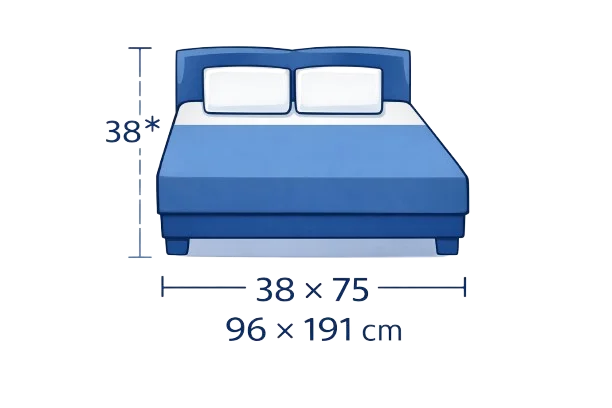
Dimensions:
- 38 × 75 inches
- 96 × 191 cm
The Twin bed size is the smallest standard adult option in the US market. It is often called a single.
Minimum recommended room size: 7 × 10 feet. This allows space for walking clearance and basic furniture.
Space comparison: A Full bed adds 16 extra inches in Width. That is a noticeable increase in personal space. Twin works best where floor space is limited. It does not suit couples.
Ideal for:
- Children
- Teenagers
- Single sleepers
- Small guest rooms
- Bunk bed setups
Twin XL Bed Size
Dimensions:
- 38 × 80 inches
- 96 × 203 cm
The Twin XL bed size keeps the same Width as a Twin but adds 5 inches in Length.
Ideal for:
- Tall teenagers
- College dorm rooms
- Guest rooms needing extra legroom
Minimum recommended room size: 8 × 10 feet
This provides basic walking clearance.
Space comparison:
A Full bed provides 16 more inches of Width but reduces Length by 5 inches.
Two Twin XL beds placed side by side equal the Width of a standard King. This setup is known as a Split King.
Twin XL solves height issues but does not increase personal Width.
Full / Double Bed Size
Dimensions:
- 54 × 75 inches
- 137 × 191 cm
The Full bed size, also called Double, has a significantly wider width than a Twin.
Ideal for:
- Single adults
- Teenagers need more space.
- Compact guest rooms
Minimum recommended room size: 9 × 10 feet
This provides basic walking clearance.
Space comparison:
A Queen adds 6 inches of Width and 5 inches of Length.While a Full can fit two adults, the space feels tight. Each person gets about 27 inches of Width. That is less than a crib mattress per person.
Full works well for solo sleepers who want extra room without upgrading to a Queen.
Queen Bed Size
Dimensions:
- 60 × 80 inches
- 152 × 203 cm
The Queen bed size is the most popular among standard bed sizes in the US.
Ideal for:
- Couples
- Master bedrooms
- Guest rooms with flexibility
Minimum recommended room size: 10 × 10 feet
Larger rooms allow easier furniture placement.
Space comparison:
A King adds 16 inches of Width but keeps the same Length.
Each sleeper gets 30 inches of personal Width in a Queen. That equals the Width of a Twin bed per person. Queen balances comfort and space efficiency. It suits most average-sized bedrooms.
King Bed Size
Dimensions:
- 76 × 80 inches
- 193 × 203 cm
The King bed size offers maximum Width among common categories.
Ideal for:
- Couples wanting extra space
- Families with young children
- Large master bedrooms
Minimum recommended room size: 12 × 12 feet
Smaller rooms feel crowded with a King.
Space comparison:
A California King is 4 inches narrower but 4 inches longer.
Each sleeper gets 38 inches of personal Width. That equals a full Twin per person.
The king prioritizes Width over Length. It works best where bedroom space allows proper clearance.
California King Bed Size
Dimensions:
- 72 × 84 inches
- 183 × 213 cm
The California King bed size shifts emphasis from Width to Length.
Ideal for:
- Tall sleepers
- Larger bedrooms
- People over 6 feet tall
Minimum recommended room size: 12 × 12 feet or larger
The added Length requires careful room planning.
Space comparison:
It is 4 inches longer but 4 inches narrower than a standard King.
This size improves legroom without significantly increasing Width beyond a King.
California King suits height requirements more than width needs.
Summary of Width Growth Across Sizes
- Twin → 38 inches
- Full → 54 inches
- Queen → 60 inches
- King → 76 inches
Each upgrade increases personal space and floor requirements. Understanding these bed sizes and measurements helps you plan room layout, furniture placement, and walking clearance accurately.
Bed Sizes by Country
Bed sizes by country vary because manufacturers follow regional standards. Names may match. Measurements often do not. This section clarifies those differences without overwhelming tables.
United States Bed Sizes
The US system defines the most widely referenced standard bed sizes online.
Common US categories:
- Twin
- Twin XL
- Full
- Queen
- King
- California King
Key characteristics:
- Length for most adult sizes is 80 inches.
- King focuses on Width.
- California King focuses on Length.
- Measurements use inches as the primary unit.
The Queen at 60 × 80 inches dominates American households. The King at 76 × 80 inches provides maximum Width among common sizes. When people search for bed sizes in the US, this is the system they’re referring to.

United Kingdom Bed Sizes
The UK uses different naming and metric foundations.
Common UK categories:
- Single
- Double
- Super King
- Small King
- King
Key characteristics:
- A UK King measures 150 × 200 cm (60 × 78 inches)
- A US King measures 76 × 80 inches (193 × 203 cm).
- They are not equivalent.
- A UK Double at 135 × 190 cm is close in Width to a US Full but slightly narrower.
UK standards also use shorter lengths for several sizes compared to the US 80-inch norm.
This difference affects sheet compatibility and imported frames.
European Bed Sizes
Europe primarily uses metric sizing. Names are less standardized than in the US.
Common European formats:
- 90 × 200 cm
- 160 × 200 cm
- 140 × 200 cm
- 180 × 200 cm
These dimensions are often measured rather than labelled as Queen or King.
Key distinctions:
- Standard Length often defaults to 200 cm.
- Width categories increase in 20 cm increments.
- Names differ by country, even within Europe.
A 160 × 200 cm bed is roughly comparable to a US Queen in Width but slightly shorter. When comparing European and American bed sizes, always convert both Width and Length.
Australia Bed Sizes
Australia blends UK influence with local adaptations.
Common sizes:
- Single
- Double
- King
- King Single
- Queen
A King Single at 107 × 203 cm has no direct US equivalent. It offers extra Width compared to Twin and a similar Length to Twin XL.
Key distinctions:
- Australian Queen and King closely match US dimensions in Width and Length.
- Buyers importing frames or sheets should verify exact centimetre measurements.
A 160 × 200 cm bed is roughly comparable to a US Queen in Width but slightly shorter. When comparing European and American bed sizes, always convert both Width and Length.
Key International Differences
- The US focuses on inch-based manufacturing.
- The UK uses metric but keeps traditional names.
- Europe favours numeric dimension labelling.
- Length standards vary between 190 cm, 200 cm, and 203 cm.
- Understanding these regional systems prevents mismatches in bed frame sizes, sheets, and imported furniture.
Bed Size Comparison Guide (Side-by-Side)
These comparisons focus on measurable differences. Width affects personal space. Length affects legroom. Room size determines the comfort of movement.
Twin vs Full
- Twin: 38 × 75 inches
- Full: 54 × 75 inches
- Width difference: 16 inches
- Length difference: No change
A Full provides significantly more personal Width. Length remains identical.
Space impact: Full requires roughly 15 per cent more floor space.
Best for:
- Twin suits kids and compact rooms.
- Full suits single adults wanting more Width.
- Couples should avoid both unless space is extremely limited.
Full vs Queen
- Full: 54 × 75 inches
- Queen: 60 × 80 inches
- Width difference: 6 inches
- Length difference: 5 inches
Queen increases both Width and Length.
Space impact: Queen requires a larger room clearance, ideally 10 × 10 feet.
Best for:
- Full suits single sleepers.
- The Queen suits couples and master bedrooms.
- Each person in a Queen gets 30 inches of Width. In a Full, that drops to 27 inches if shared.
Queen vs King
- Queen: 60 × 80 inches
- King: 76 × 80 inches
- Width difference: 16 inches
- Length difference: No change
King dramatically increases the Width.
Space impact: King fits best in rooms 12 × 12 feet or larger.
Best for:
- Queen suits average-sized rooms.
- King suits couples who want maximum personal space.
- Each sleeper in a King receives 38 inches of Width.
King vs California King
- King: 76 × 80 inches
- California King: 72 × 84 inches
- Width difference: King is 4 inches wider
- Length difference: California King is 4 inches longer
This tradeoff shifts space from Width to Length.
Space impact: Both require large bedrooms with clear walking space.
Best for:
- King suits couples prioritizing Width.
- California King suits tall sleepers needing extended legroom.
Minimum Room Size for Each Bed Size
Choosing a bed size without measuring your room can lead to layout problems. Width and length matter, but clearance determines comfort. A bed that technically fits may still make the room feel cramped.
Interior design associations and architectural layout standards recommend 24 to 36 inches of walking space around the bed. This clearance allows movement, drawer access, and safe navigation. Below is a practical breakdown based on common bedroom dimensions.
8 × 10 Foot Room
An 8 × 10 room equals 80 square feet. This is compact.
Best fit:
• Twin
• Twin XL
A Full bed can fit, but clearance becomes tight. You may lose space for nightstands.
Not recommended:
• Queen
• King
• California King
With a Twin in this room, you can maintain 2 feet of walking space on one side and at the foot of the bed. A Full reduces that clearance significantly.
This size works for guest rooms or children’s rooms.
10 × 10 Foot Room
A 10 × 10 room equals 100 square feet. This is a common small bedroom size.
Best fit:
•Twin
• Twin XL
• Full
A Queen bed in a 10 × 10 room leaves limited clearance. Expect about 20 to 24 inches on each side. You must plan nightstands carefully.
Not recommended:
• King
• California King
For a balanced layout and proper room flow, a Full often feels more proportional in this size.
12 × 12 Foot Room
A 12 × 12 room equals 144 square feet. This is ideal for larger standard bed sizes.
Comfortable fit:
• Queen
• King
• California King
A King bed fits well in this room, with 30 inches of walking space on each side when centred properly.
A California King also works, especially for taller sleepers, though furniture placement must account for added Length.
This size supports full bedroom sets.
Clearance Guidelines
For functional bedroom design:
- Leave at least 24 inches on one side of the bed.
- Aim for 30 to 36 inches of walking clearance for comfort.
- Keep 24 inches clear at the foot of the bed.
- Account for door swing and closet access.
These recommendations apply regardless of region or country standards.
Quick Reference: Bed Size vs Room Size
- Twin works in 8 × 10.
- Full works in 9 × 10 or larger.
- Queen works best in 10 × 10 or larger.
- King requires a 12 × 12 layout for a balanced layout.
- California King also requires a minimum of 12 × 12.
Understanding room dimensions prevents overfilling small spaces and preserves usability.
Special & Non-Standard Bed Sizes
Beyond common categories, several non-standard bed sizes serve specific needs. These are less common but widely searched.
Olympic Queen
Dimensions:
66 × 80 inches
168 × 203 cm
This size adds 6 inches of Width over a standard Queen.
Best for:
Couples who want more space but cannot fit a King.
It maintains the same Length as a Queen, making it compatible with most bedroom layouts designed for Queen length.
Sheets and frames may require speciality ordering.
Texas King
Dimensions:
80 × 98 inches
203 × 249 cm
Texas King dramatically increases both Width and Length.
Best for:
Very large bedrooms
Families sharing sleeping space
This size demands a significant floor area. Rooms should be at least 14 × 16 feet for practical use.
Alaskan King
Dimensions:
108 × 108 inches
274 × 274 cm
This is one of the largest residential options available.
Best for:
Open-concept master suites
Multiple sleepers
It requires custom bedding and specialized frames. Standard sheet sets will not fit.
Among the largest bed sizes, the Alaskan King remains the most commonly referenced option.
RV Bed Sizes
Recreational vehicles use modified dimensions to match compact layouts.
Common RV formats include:
• Short Queen
• RV King
• Three Quarter
Lengths may range between 74 and 80 inches.
Width often mirrors residential sizes, but Length differs.
Always confirm exact measurements before ordering sheets or frames.
RV standards vary by manufacturer, not national guidelines.
Split King
Dimensions:
Two Twin XL beds combined
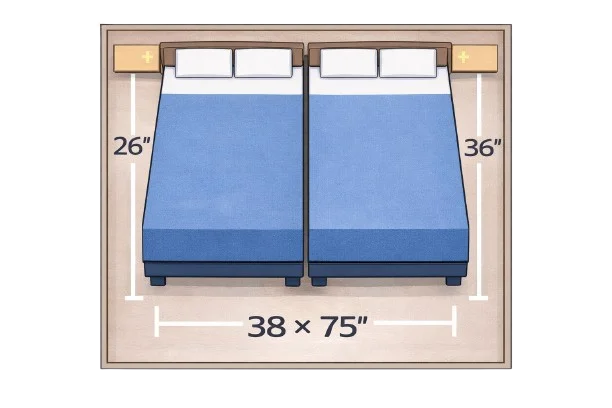
Each 38 × 80 inches
The combined Width is 76 inches, matching a standard King.
Best for:
Couples with adjustable bases
Partners with different firmness preferences
Split King allows independent movement while maintaining overall Width.
It matches King dimensions when placed side-by-side.
These speciality options expand beyond common types of bed sizes. They serve unique room layouts and personal needs.
Bed Sizes for Different Situations
The right choice depends on space, height, and how many people share the surface. This section connects bed sizes and dimensions to real-world needs using only measurement logic.
Best Bed Size for Tall Sleepers
Height determines length requirements.
If the sleeper exceeds six feet:
- Twin XL – 80 inches long
- Queen – 80 inches long
- King – 80 inches long
- California King – 84 inches long
California King provides the most Length among common options. Length matters more than Width for tall individuals. Avoid 75-inch beds if the height exceeds six feet. Always compare bed sizes in inches to personal height before deciding.

Best Bed Size for Small Bedrooms
Small bedrooms demand efficiency.
In rooms under 100 square feet:
- Twin fits comfortably.
- Full fits with careful planning.
In a 10 × 10 room:
- Queen works but reduces clearance
If walking space drops below 24 inches, movement feels restricted. For studio apartments or compact layouts, Twin XL often offers greater Length without increasing Width.Choose based on room dimensions, not preference alone.
Best Bed Size for Kids
Children require flexibility as they grow.
For toddlers and young children:
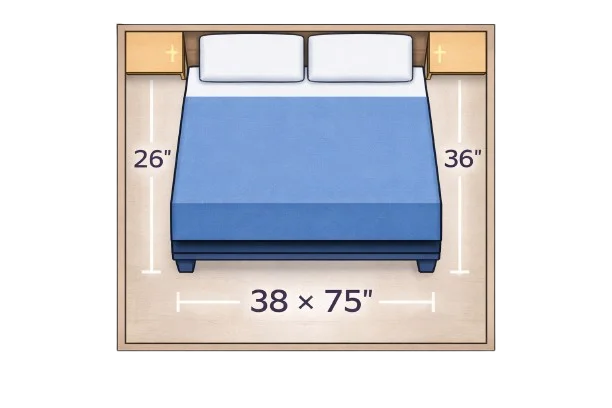
- Twin – 38 × 75 inches works well.
For teenagers or fast growth periods:
- Twin XL – 38 × 80 inches provides added legroom.
If space allows, a Full supports long-term use. Avoid oversizing. Large frames reduce play and storage space in smaller rooms. Kids benefit from efficient layouts that preserve open floor area.
Best Bed Size for Couples
Couples need balanced Width and adequate Length.
Minimum recommendation:
Queen – 60 × 80 inches (152 × 203 cm)
Each person gets 30 inches of Width. That equals a Twin per sleeper.
More space option:
King – 76 × 80 inches (193 × 203 cm)
Each person gets 38 inches of Width. That matches a full Twin per person.
When to choose a California King:
Suppose one or both partners exceed six feet in height. It adds 4 inches of Length over a standard King. Avoid a Full for two adults. It provides only 27 inches per person. For most bedrooms, Queen offers the best balance between floor space and sleeping space.

How to Measure Your Room for a Bed
Accurate measurement prevents layout mistakes. Follow these steps before selecting a bed size.
Step 1: Measure Room Width
- Use a tape measure across the shortest wall.
- Record the Width in feet and inches.
- Convert to centimetres if needed.
- This determines maximum bed width.
Step 2: Measure Room Length
- Measure the longest wall from corner to corner.
- This defines available bed length plus clearance.
- Compare these numbers to standard bed dimensions.
Step 3: Account for Doors and Windows
Mark the door swing radius.
Ensure the bed will not block:
- Entry paths
- Closet doors
- Window access
Door clearance often reduces usable Width by 2 to 3 feet.
Step 4: Leave Walking Clearance
Maintain:
- 24 inches minimum on one side
- 30 to 36 inches preferred for comfort
- 24 inches at the foot of the bed
This ensures safe and practical movement. Do not push the frame against the wall unless the room design requires it.
Step 5: Consider Other Furniture
Account for:
- Nightstands
- Dressers
- Wardrobes
- Desks
Subtract their footprint from the total floor area. A King may technically fit, but leave no space for storage.
Practical Measurement Rule
The room width minus the bed width should leave at least 48 inches of combined clearance.
For example:
- 12-foot room width equals 144 inches.
- King bed width equals 76 inches.
- The remaining space equals 68 inches.
- That allows 34 inches per side, which meets recommended guidelines.
Understanding bed measurement sizes in relation to room layout ensures proper planning and avoids overcrowding.
FAQs